

There Is One Root. Six Branches
The WHOLE Framework, Part 2

In the last post, I introduced CHAINS. Six pathways driving cognitive decline in midlife women: Cognitive decline, Hormonal disruption, Autoimmune dysregulation, Inattention/ADHD, Neurological fog, and Stress and burnout.
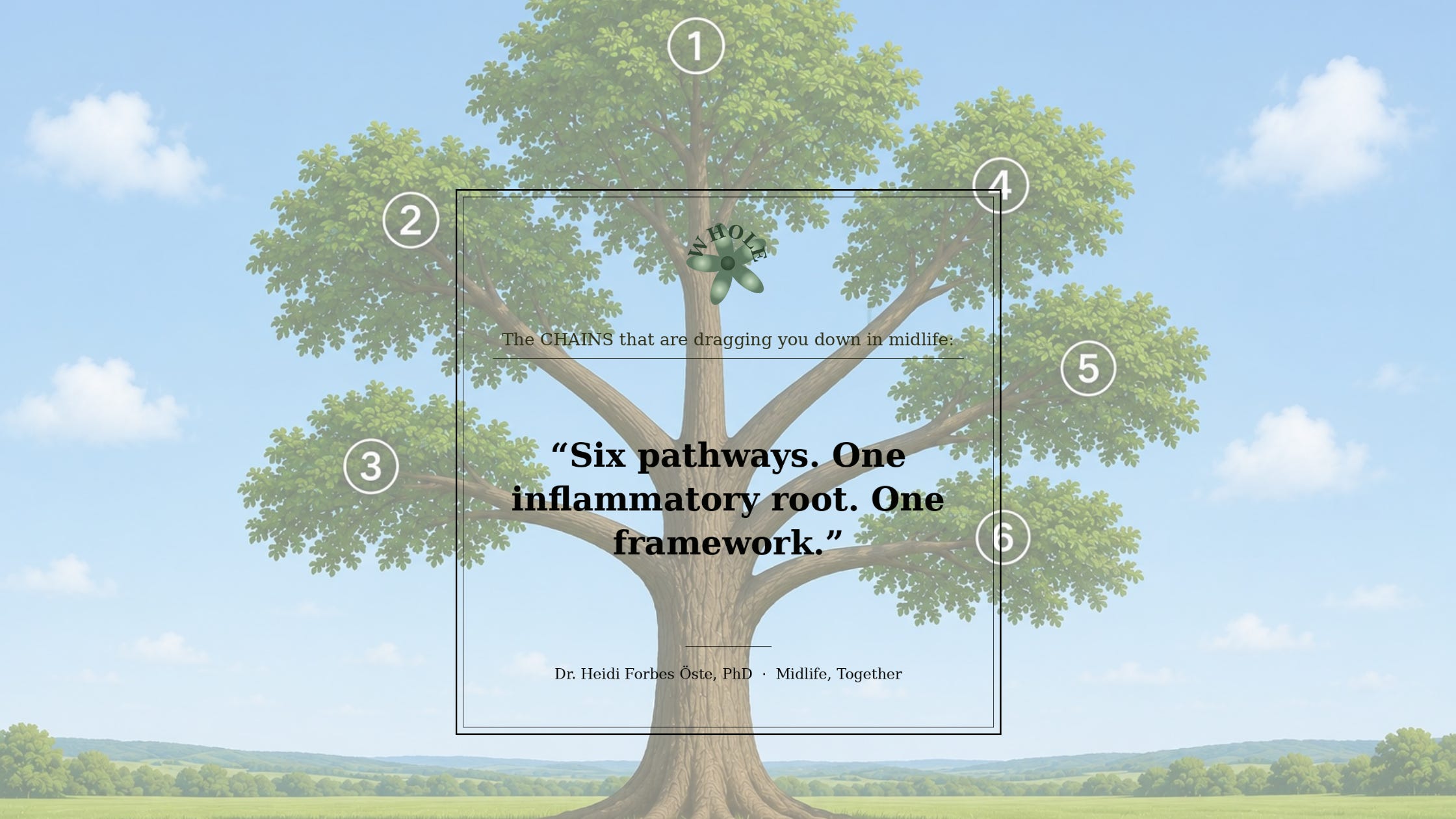
Several of you wrote back saying the same thing in different words: “I have all of these.”
That’s not a coincidence. And it’s not bad luck.
If these pathways showed up in isolation, we would expect to see women struggling with one or two of them. But they cluster. They compound. They reinforce each other in ways that feel impossible to untangle.
There’s a reason for that. They share a root.
The Mechanism Underneath CHAINS
Researchers have been building the case for decades. The term is chronic low-grade inflammation, sometimes called “inflammaging,” a concept developed by immunologist Claudio Franceschi and colleagues to describe the slow, persistent, low-level inflammatory state that accumulates as we age.
I use a more specific formulation in my work: Systemic Low-Grade Chronic Inflammation, or SLGCI.
SLGCI is not the inflammation you feel after a sprained ankle. It is not an infection your body is fighting. It is quieter, slower, and far more damaging over time, precisely because it operates below the threshold of standard clinical detection. Your blood work may look normal. Your doctor may find nothing acute. And yet the inflammatory signaling is running in the background, disrupting systems that depend on a stable neurological environment.
The research is now clear on this. A major study within the Atherosclerosis Risk in Communities cohort tracked over 12,000 participants across 20 years and found that higher systemic inflammation measured during midlife was directly associated with greater cognitive decline two decades later. This was not a study of sick people. These were adults in middle age, many of whom had no obvious symptoms. PubMed Central
A separate Finnish prospective cohort study found that chronic low-grade inflammation in midlife, measured by markers including IL-6, TNF-alpha, and high-sensitivity CRP, predicted cognitive decline at a 10-year follow-up. nih
This is not a fringe hypothesis. It is an emerging scientific consensus. And it sits at the center of everything WHOLE was built to address.
How SLGCI Feeds Every Link in CHAINS
Here is where it gets important. SLGCI does not cause one problem. It creates the conditions for all of them.
C: Cognitive decline Chronic neuroinflammation disrupts synaptic plasticity, the brain’s ability to form and maintain connections. It also impairs the brain’s waste-clearing systems, allowing proteins associated with Alzheimer’s pathology to accumulate faster than the brain can clear them. The cognitive decline we are working to prevent is, in large part, an inflammatory story.
H: Hormonal disruption This connection is especially relevant for midlife women. Estrogen promotes an anti-inflammatory state in the brain, actively downregulating pro-inflammatory cytokines including IL-1beta, IL-6, and TNF-alpha. As estrogen fluctuates and declines through perimenopause, the brain loses a key buffer against inflammatory signaling. Estrogen decline during perimenopause negatively influences almost every tissue and organ in the body, including the brain, and this estrogen loss leads directly to increased inflammation. Perimenopause is not just a hormonal event. It is a neuroinflammatory event. FrontiersMDPI
A: Autoimmune dysregulation Autoimmune conditions are fundamentally inflammatory. Systemic inflammation and immune dysregulation are associated with increased dementia risk, and conditions like lupus are linked to elevated neuroinflammation and vascular harm in the brain. SLGCI both triggers and sustains autoimmune activity, creating a feedback loop that many women carry undetected for years. PubMed Central
I: Inattention and ADHD Neuroinflammation impairs dopamine regulation and prefrontal function, the exact systems underlying attention, working memory, and executive control. Women with ADHD, especially those undiagnosed until midlife, often find that hormonal shifts amplify their attentional difficulties significantly. SLGCI helps explain why.
N: Neurological fog Fog is not a vague complaint. It is a subjective experience of a brain operating under inflammatory load. Research consistently links elevated systemic inflammation, including IL-6 and TNF-alpha, to domain-specific cognitive impairment even in adults without established cognitive decline or dementia. When women describe fog, they are describing something real and measurable. ScienceDirect
S: Stress and burnout Chronic stress elevates cortisol. Chronically elevated cortisol promotes inflammatory signaling. This is not metaphor. Elevated systemic inflammation in midlife, indexed by CRP, has been prospectively associated with steeper cognitive decline over the following 20 years. Stress does not just feel harmful to the brain. It is structurally harmful, and SLGCI is part of how that harm accumulates. PubMed Central
Why This Changes the Intervention Logic
If SLGCI is the shared root, then fragmented single-pillar interventions will always underperform.
A supplement for hormones. A meditation app for stress. A sleep tracker for fatigue. Each addresses one branch. None of them touches the root.
This is the core design logic behind WHOLE. Once you understand that CHAINS pathways share a common inflammatory mechanism, the intervention architecture becomes obvious. You need a multi-domain approach that reduces SLGCI across all five pillars simultaneously. That is exactly what the FINGER trial showed works. And that is exactly what WHOLE was built to deliver.
CHAINS as Your Map Going Forward
SLGCI is the mechanism. CHAINS is the map.
In every post from here forward, I’ll be using CHAINS as a diagnostic lens. You’ll be able to look at each pillar of the WHOLE framework and ask: which of my CHAINS pathways does this address? How does it reduce my personal inflammatory load?
Some of you will recognize yourself most strongly in H and S. Others in A and N. Many of you will see yourself across all six. That’s not overwhelm. That is useful information. It tells you where your system is under the most pressure, and where to focus first.
CHAINS is not a diagnosis. It is a navigation tool. And now that you understand the root underneath it, you have something more than a list of symptoms. You have a framework for understanding why your body and brain have been responding the way they have, and what actually moves the needle.
What’s Next
In the next post, I’ll introduce the five pillars of the WHOLE intervention: Movement, Enrichment, Nourishment, Mindfulness, and Connection. I’ll show how each pillar was chosen specifically for its effect on SLGCI, not just general wellness, and how they map back to your CHAINS pathways.
This is where the science becomes a practice.
Heidi Forbes Öste, PhD is the founder of 2BalanceU AB and the creator of WHOLE, a brain longevity platform for midlife women grounded in the FINGER trial. She writes at the intersection of behavioral science, healthspan, and digital self-mastery.